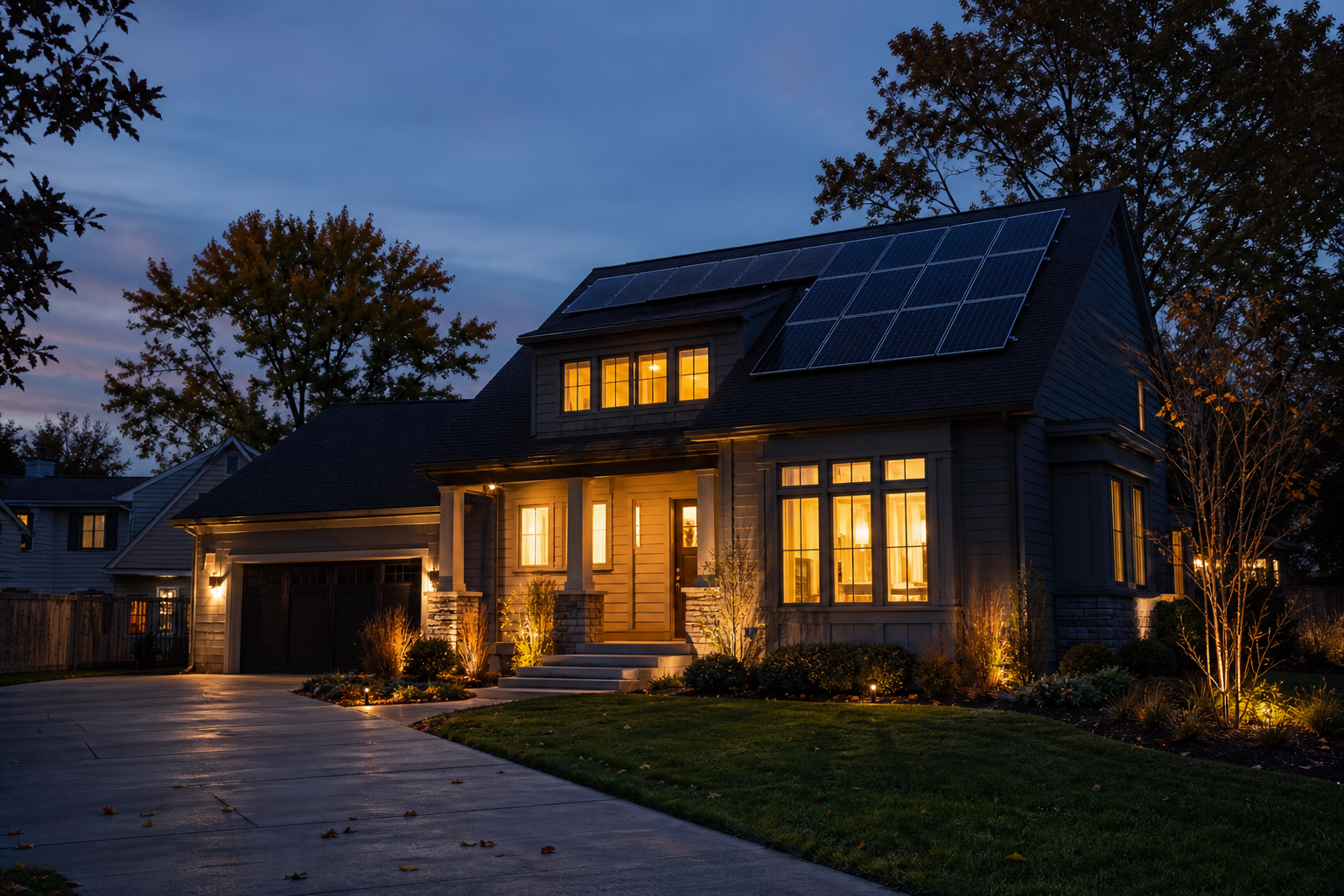
Solar panels can lower utility bills and may qualify for Illinois property-tax relief, but their effect on resale value in Kankakee County depends on ownership structure, system age, roof condition, and what buyers are willing to pay, there’s no guaranteed premium.
Should Kankakee County homeowners install solar panels?
Solar panels can reduce monthly utility costs and may qualify for a special Illinois property-tax assessment, but their effect on resale value in Kankakee County is not guaranteed. Whether a system makes financial sense depends on how you finance it, your roof’s remaining life, your ComEd net-metering eligibility, and how future buyers in your specific town will respond to a solar-equipped home.
Key Takeaways
- Illinois homeowners may qualify for a solar special assessment under the PTAX-330 process, which can limit how a solar system affects your property-tax bill, but filing with the Kankakee County assessment office is required.
- New ComEd solar customers who entered service on or after January 1, 2025 receive credits for supply charges only, not for delivery charges or taxes and fees, a meaningful difference from legacy full-retail net metering.
- Owned solar systems are significantly easier to transfer at resale than leased systems or systems tied to a power-purchase agreement, which may require buyer qualification or lender approval.
- The most recent local market data shows a median sale price of $184,500 in Kankakee and $307,250 in Bourbonnais, individual home value depends on condition, street, and timing, not a countywide solar premium.
- No verified Kankakee County-specific data confirms a dollar or percentage resale premium for homes with rooftop solar panels; a local appraiser using comparable sales is the right source for an address-specific opinion.
What are the real benefits of solar panels for a Kankakee County home?
The honest answer is that solar can be a smart long-term move for the right homeowner, but the benefits are more nuanced than most sales pitches suggest.
Lower monthly energy costs (with an important caveat for 2025-and-later customers)
Reducing your ComEd bill is the most straightforward benefit. A properly sized system can offset a meaningful portion of your supply charges. But if your system entered service on or after January 1, 2025, the credits you earn for electricity you export back to the grid apply to supply charges only, not to delivery charges, taxes, or fees. That’s a significant change from the legacy full-retail net metering that earlier customers still enjoy, according to the Illinois Solar Energy and Storage Association. Before you run any payback math, verify your specific tariff directly with ComEd.
Illinois property-tax protection, if you file for it
Illinois has a special property-tax assessment designed to prevent a rooftop solar installation from automatically driving up your tax bill. Under guidance from the Illinois Department of Revenue, a qualifying solar-energy system may be valued at the lesser of its value with the solar system or its value with a conventional heating or cooling system. To get that treatment, you need to file the PTAX-330 form with the local chief county assessment officer. This is not automatic, you have to ask for it. Confirm the filing deadline, required documentation, and renewal requirements directly with the Kankakee County assessment office, because those details can change.
Illinois Solar for All, income-qualified access
If cost is a barrier, it’s worth checking the Illinois Power Agency’s Solar for All program. The Kankakee metropolitan statistical area is listed in the program’s eligibility materials, and income thresholds are set by household size. Eligibility tables change by program year, so use the current application materials rather than anything you read more than a few months ago.
Federal tax incentives, check current IRS guidance
A residential federal investment tax credit was widely discussed for solar installations, but the status of that credit as of September 2026 is a time-sensitive tax question. I’m not a tax advisor, and this is one you need to confirm with your own CPA or tax professional using current IRS guidance before you factor any credit into your payback calculation.
Do solar panels increase home value in Kankakee County, and what happens when you sell?
This is the question I hear most often, and it deserves a straight answer: the evidence doesn’t support a guaranteed resale premium for rooftop solar in Kankakee County specifically.
The Solar Energy Industries Association cites an Illinois study finding that properties within one mile of a utility-scale solar farm increased in value by an average of 2% after installation. That’s proximity to a large solar farm, not a rooftop system on a residential home. Those are two very different things, and it would be misleading to apply that number to your roof. The Illinois Solar Energy and Storage Association also notes that studies of utility-scale solar facilities generally show no consistent negative effect on adjacent property values, again, large-scale, not residential rooftop.
For a home with panels, resale impact depends on ownership structure, system age, remaining loan or lease obligations, roof condition, transferable warranties, production history, and what buyers in your specific town are actually willing to pay. A local appraiser using real comparable sales is the only credible source for an address-specific valuation opinion. I always look at what’s actually selling in your town, not a countywide average, and right now, the market varies meaningfully across the county.
| Area | Median Sale Price | Median Days on Market |
|---|---|---|
| Bourbonnais | $307,250 | 60 |
| Bradley | $225,000 | 51 |
| Kankakee | $184,500 | 63 |
| Manteno | $336,250 | 51 |
| Momence | $225,000 | 35 |
Recent local market data, trailing ~90 days as of September 2026. Area-level medians, individual home value varies by condition, street, build year, and timing.
Own versus lease: the single biggest resale factor
Owned systems are far easier to present as part of the real estate at closing. A buyer sees it as an asset that transfers with the home, the title company handles it like any other fixture, and there’s no third-party approval needed.
Leased systems and power-purchase agreements are a different story. A buyer may need to qualify to assume the lease, buy out the remaining balance, or get lender approval, and some buyers simply won’t want the complication. That can shrink your buyer pool or require a price concession that offsets any energy savings. Before you sign a solar contract, understand exactly how the agreement transfers (or doesn’t) if you sell. Get that in writing from the solar provider.
Roof timing and documentation, two things most homeowners overlook
Installing panels on a roof that needs replacement in the next few years is a costly mistake. Removing and reinstalling a solar array adds expense and may void warranties. Before signing any solar contract, get an honest assessment of your roof’s remaining useful life from a qualified roofing contractor, not the solar installer.
If you already have solar and plan to sell, assemble your documentation now: installation contract, proof of ownership, equipment specifications, permits, interconnection records, warranty documents, inverter information, production history, and any loan, lease, or power-purchase agreement. A buyer and their appraiser will want all of it. Missing paperwork slows closings and creates negotiating leverage for the buyer, not for you. This is exactly the kind of preparation I walk my clients through well before we list.
Your specific situation, roof age, financing structure, production history, and what buyers in Bourbonnais, Bradley, Manteno, or Kankakee are paying attention to right now, is what determines whether solar adds to your sale price or creates friction. That’s a conversation worth having before you make a six-figure decision.
If you’re thinking about selling a solar-equipped home and want to know what buyers in your town are actually doing, I’ve covered the value question in more depth here. And if you’re still figuring out where you stand financially before deciding whether to sell, knowing your real equity position is always the right starting point.
Ready to talk through how solar factors into your home’s value in this market? Reach out and let’s run the numbers together.
Read what past clients have to say about working with me on Google Reviews.
Frequently Asked Questions
Do solar panels increase a home’s resale value in Kankakee County?
There is no verified Kankakee County-specific data confirming a dollar or percentage resale premium for homes with rooftop solar panels. Resale impact depends on whether the system is owned or leased, the system’s age and production history, roof condition, transferable warranties, and what buyers in your specific town are willing to pay, a local appraiser using comparable sales is the right source for an address-specific opinion.
Is it better to own or lease solar panels when selling a house in Illinois?
Owning your system outright is significantly easier at resale. An owned system transfers with the home like any other fixture, with no third-party approval or buyer qualification required. A leased system or power-purchase agreement may require the buyer to assume the contract, qualify with the solar company, or arrange a buyout, any of which can complicate or delay closing and reduce your buyer pool.
How does ComEd net metering work for a Kankakee County homeowner in 2026?
For systems that entered service before January 1, 2025, legacy full-retail net metering generally applies. New customers whose systems entered service on or after January 1, 2025 receive credits for supply charges only, not for delivery charges, taxes, or fees, according to the Illinois Solar Energy and Storage Association. Verify your specific tariff directly with ComEd before relying on any payback estimate.
Will solar panels increase my Kankakee County property taxes?
Not necessarily, if you file for the right treatment. Illinois allows a solar special assessment that can limit how a qualifying system affects your taxable value, but you must file the PTAX-330 form with the Kankakee County chief county assessment officer to receive it, per the Illinois Department of Revenue. This is not automatic, and you should confirm filing deadlines and documentation requirements directly with the county assessment office.
What happens to solar panels when I need to replace my roof?
The panels need to be removed and reinstalled, which adds cost and can complicate or void warranties. Before signing any solar contract, have a qualified roofing contractor assess your roof’s remaining useful life, not the solar installer, whose incentive is to close the sale. If your roof needs replacement within the next several years, it’s worth addressing that first.
Is community solar a better option if my Kankakee County roof is shaded?
Community solar can be a practical alternative if your roof isn’t well-suited for panels due to shading, orientation, or structural limitations. You subscribe to a share of a larger off-site solar array and receive credits on your utility bill without any rooftop installation. Check the Illinois Power Agency for current community solar programs available in Kankakee County.
Equal Housing Opportunity. Dawn Olson is a Licensed Real Estate Broker regulated by the Illinois Department of Financial and Professional Regulation. This article is general information only, not legal, tax, or financial advice. Confirm your own numbers with your title company, tax advisor, or lender.
Leave a Reply